Customer Feedback Monitor
What if the product team never had to go looking for what customers were saying?

01Scope
7
sources in one bot, where the plan was one person per source
1
lane I was handed: the app store reviews
5
digests a week, one every weekday, until I left
The VP wanted every PM and designer holding a lane. Mine was the app store reviews, someone else had Reddit, someone else the feedback responses, then Google News, then TikTok, and so on. When it was pitched I wondered whether a bot could do the whole thing. The VP was all for it and let me explore, and after a lot of learning it ran.
02What it is
An automated pipeline that watches customer feedback across the App Store, Google Play, Reddit, X, Facebook, Trustpilot and Google News, analyses and clusters it, and posts a digest to Slack every weekday morning. During a launch window it also runs hourly to catch app-breaking issues in real time.
03Why it belongs here
- 01Multi-source ingestion with fallback chains per source, so one dead API does not take the digest down
- 02LLM enrichment and clustering, so the output is themes
- 03A feedback loop: the team replies with commands in the Slack thread and the bot reconfigures itself
- 04Orchestrated on GitHub Actions with an external scheduler, so there is no server to babysit and nothing that needs a hand. The only thing that stops it is the model credit running out. It was posting every weekday when I left
This site is about noticing that nobody reads the reviews, then building the thing that does.
04How it runs
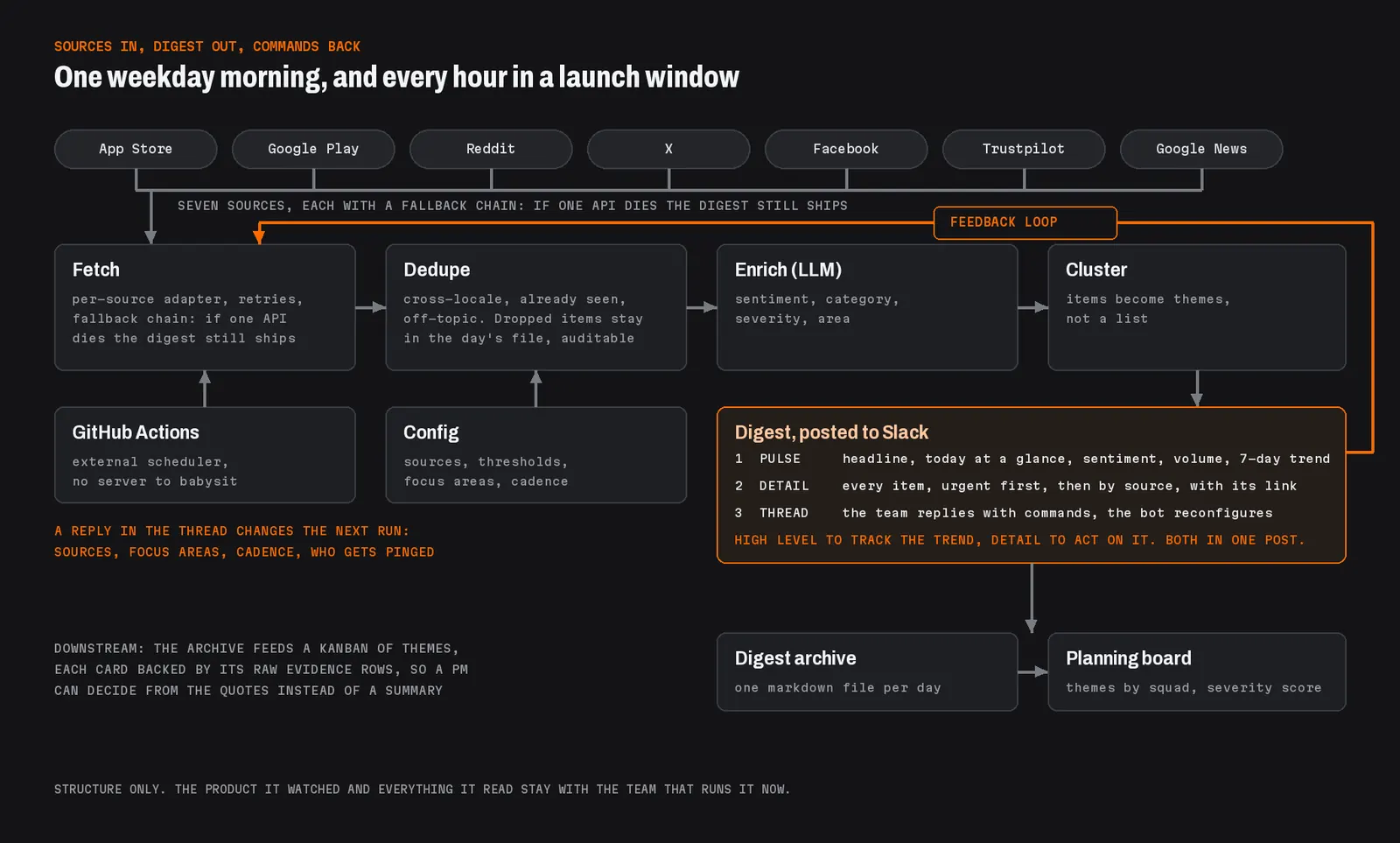
Nothing it read is shown here. The feedback belonged to the company and the bot now runs inside their team. The diagram above is the shape. The digest below is that shape with invented numbers for an invented app.
05What I dropped
TikTok and Instagram as sources, each account watchedmainly the price of the Apify actors that read them.
06The digest
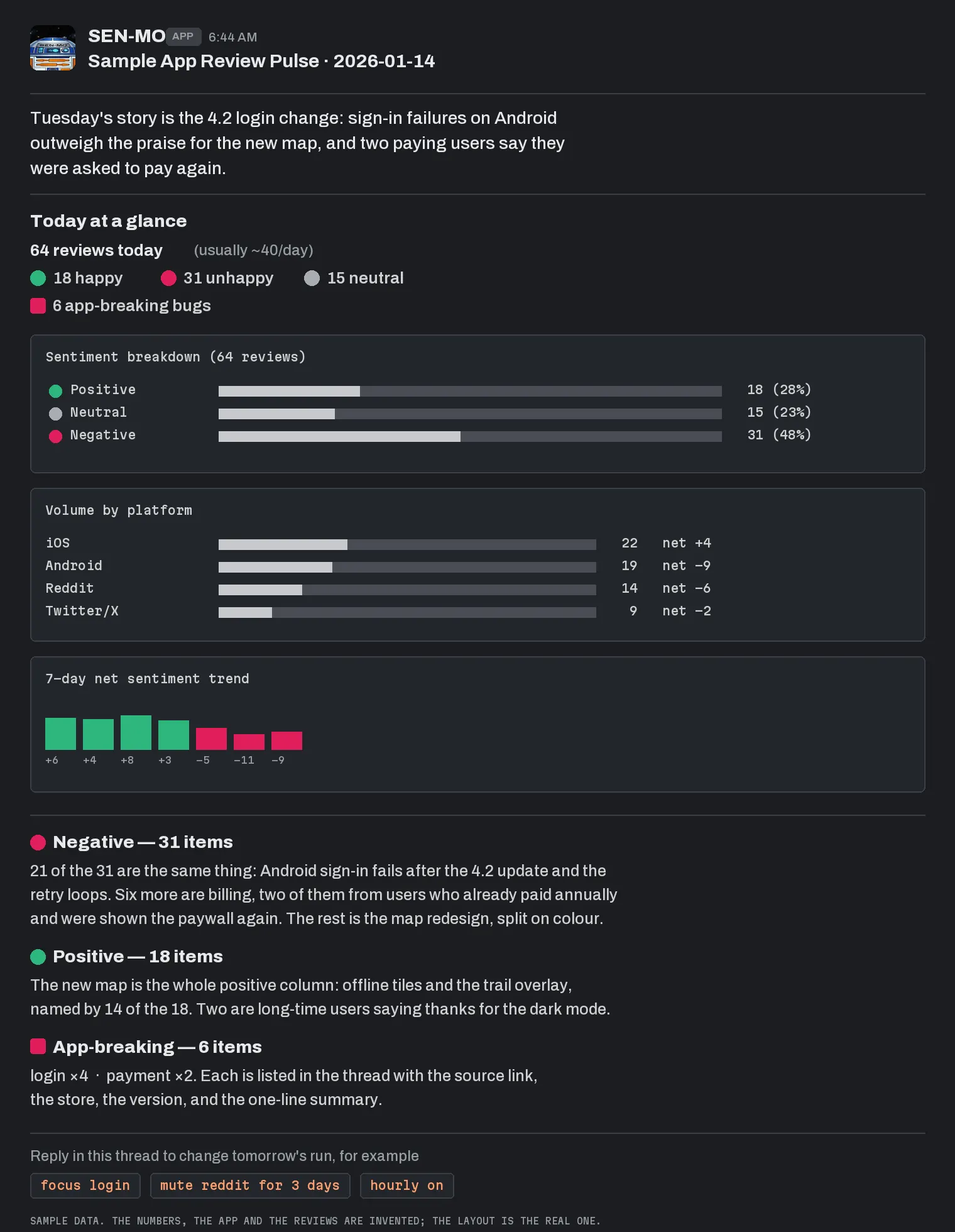
It does two jobs in one post. The top is a summary so the team can track how we are doing without reading anything: one headline, the day's counts against a usual day, sentiment, volume by platform, a seven-day trend. Under it is the detail, every item the summary was built from, urgent ones first, then by source, each with its link, its store and its version. The summary says whether today is normal, and the detail is where you act. Every item carries its source link, so any theme can be checked back to the comment it came from, and I checked the sources were real when I built it. The sentiment labels were never scored against a hand read.
The team steers it from the thread. Reply with a command and the next run picks it up: which sources to mute, which area to focus on, whether to go hourly. Nobody has to open a config file to change what the bot does. Commands came back in the thread, posts got reactions, the bot got quoted in other channels, and people brought up what it had said that morning in person.
07From digest to board
The digest archive, one file per day, fed a kanban I built next. Every item is deduped across days, categorised as bug, enhancement, new feature, praise, venting or off-topic, given an area and a severity, then grouped by the squad that owns the area and sorted by a severity score so a PM reviews the most important first. Each theme card carries its raw evidence rows and their links, so the decision is made from the quotes. Before I left I handed a board to every product manager to cycle their own domain through, and my VP took it as the format for the rest. The feedback was that it surfaced evidence they had not seen. What happened to it after I left I cannot see.
Statuses follow the review rather than the roadmap: unreviewed, discuss, ticketed, dismissed, and parked for feature asks that are out of scope for a bug pass. Praise and venting never become cards. They roll up per area on an overview tab, because a PM needs to know the mood without triaging it.